Recap: Automation and AI in Online Communities (Community Roundtable)

This recap is from Community Roundtable’s Community Conversations podcast on “Automation and AI in Online Communities”


My takeaways

Use cases for using AI in the Autodesk Community:

  • Filter through data to create themes of what they’re hearing in the community
  • Language translations for localized content
  • Repetitive jobs (administrative and operational) to focus on relationship-building in their community

On community evangelism:

  • Awareness efforts to amplify what’s in it for customers
  • Add value proposition in messaging
  • Look at the ones who are evangelizing – strong with customer engagement and getting them in the community, speaking at events, writing about it. It’s a team effort.
    • Grassroots vs. marketing campaign

Notes to self

  • Look into using AI to filter through data to find common discussion themes
  • Look into community evangelism program ideas

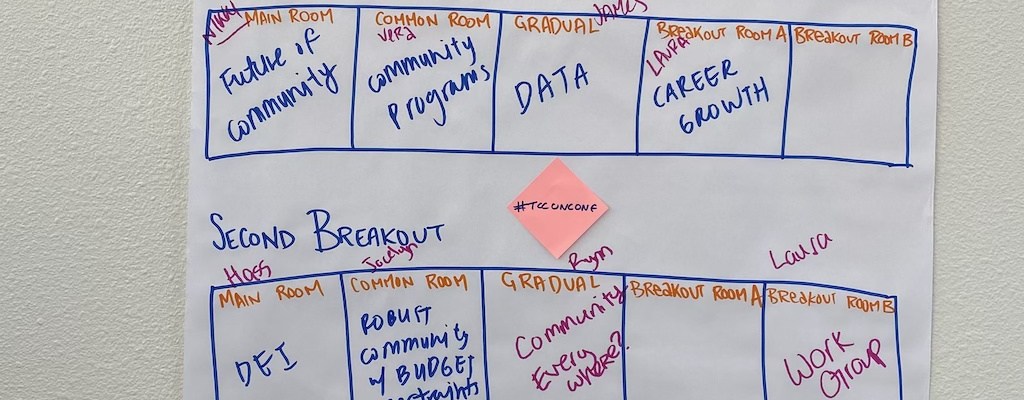
[Notes] The Community Community Unconference (2023)

Session 1 – Data

  • Data
    • Benchmarking (Analysis happens as part of BM)
    • Forecasting
    • “Truth is in the trend, power is in the pattern”
  • Tools
    • What to collect
    • how to collect it
    • Orbit, Common Room, Threado
  • Chris Mercer measurement framework

Session 2 – Building a robust community with budget restraints

[Recap] How to Reinvigorate an Inactive Community

Recap notes from CMX 2023 Summit session. Grammatical errors and typos are my own 🙂

Abstract

Is your community feeling a bit quieter than usual? Have you observed a decline in member activity, leaving you concerned about the health and vibrancy of your once-thriving group? If so, don’t despair – there’s a path to revitalization, and we’re here to guide you through it! Join us for an engaging and interactive session where we will delve deep into the art of reinvigorating an inactive community. In this illuminating workshop, we will equip you with the knowledge, tools, and strategies to breathe new life into your community and rekindle the spark of engagement. You will learn about the key signs to look out for to measure engagement, tips to re-engaging dormant members and the frameworks used to prevent communities becoming inactive in the first place. By the end of this workshop, you’ll be armed with a comprehensive toolkit to assess, re-engage, and rejuvenate your community. – Paz Pisarski, Co-Founder, The Community Collective

Notes

Inactivity is related to engagement

Key signs to be aware of

  • Low engagement – not all of your members will engage (99/1 rule where 1% will engage, 99% lurkers, consumers, etc.)
  • Minimal attendance
  • Constructive feedback – feedback is a gift if given in a constructive and kind manner
    • Decide which feedback is relevant – especially the repetitive ones
  • Members leaving
  • Lack of retention – attendees not coming back or bringing people with them
  • Lack of referrals – how are people joining the community and what %age are from referrals?
  • Slow growth and is declining
  • Crickets

Reasons for an inactive community

  • Offerings – is community offering benefits that is beneficial to members? Do they really want to meet 1-on-1?
  • Team – wrong team member hired (bad fit) and not growing community
  • Vision – are you going in a different way than the members want
  • Member fit – While communities should be inclusive, but should also be exclusive by design. When there’s a niche, they feel more connected and want to stick around
  • Tech tools – they don’t like the tech chosen and don’t use it
  • Scheduling – is it the wrong time when they can’t make it?
  • Community is always on – members can disengage if there’s not accountability to what you’re offering. Scarcity also fuels engagement and will feel accountability
  • Bad eggs – member who is not the right fit

Action plan and tactics to re-engage members

  • Interviews – talk to your members. Ask them why they are not engaging and what would make them engage
  • Surveys with 5-7 questions – make sure you’re getting a voice of the majority
  • Research – what are the trends of engagement. is it a theme? What are other communities doing?
  • Announce that you are doing something in the Community – include members on the ride for this
  • Strategy review – are we heading in the right direction?
    • Begin with the end in mind – is the business going in the same direction as the members?
  • Feedback – get more feedback from members. Different that interviews and surveys. Getting data from surveys and coming up with next steps. Then go back to the community and get their feedback on your design.
  • Data and Insights – make data-driven decisions. Make sure data is meaningful to pull key insights to make sure your efforts are worthwhile
  • Who, not how – focus on people

Tactics (How)

  • Co-creation – they get invested in the creation and strategy
  • Member roles – spend time engaging with really engaged members to help the more disengaged members to make more value of the community
  • Rituals
  • Surprise and delight – gifts for them to think about engaging in community
  • Gamification
  • Scarcity and Timing – don’t always have that offering on (limit offerings)
  • Rewards and incentives – thank them for the work they’re doing and send a gift
  • Voting – encourage members to co-create and vote for the incentives

[Recap] Fostering Community Growth by Tapping Into Your People’s Expertise

Recap notes from CMX 2023 Summit session. Grammatical errors and typos are my own 🙂

Abstract

Are you maximizing your community’s potential? When you harness the collective knowledge and skills of your community members and workforce, you can unlock new possibilities by creating a sustainable ecosystem fueled by meaningful knowledge sharing and continuous learning. Join us as we explore how to tap into your people’s expertise to foster collaboration, innovation, and engagement in your community. We’ll discuss how to leverage teams and resources across your organization to enhance your strategy and build the internal support you need to create a thriving and sustainable community. – Larry Imgrund, Product Manager, Khoros and Monique van den Berg, Head of Online Community at Atlassian (Principal Online Community Lead), Atlassian

Notes

Atlassian Community – team of 54 people. Goal is to turn users into champions

  • Learning (training & certification)
  • Online Community (forums and groups)
  • ACE (in-person and hybrid events)
    • including community-led events

Community Strategy

  • Remind teams that community exists and convincing teams that it’s worth investing (storytelling)

Focus on customers and advocates

Community leaders program

  • Answer 40% of questions on the community and go above and beyond
    • Develop initiatives, make videos, etc.
  • Next level down – “rising start”
  • What keeps them coming back? Survey them.
    • Learned a lot. I’m still learning
    • Learned a lot. I want to give back
    • Perks: front-row seats, trips with founders, exclusive swag, etc., vouchers for certifications – competitive element
      • Philanthropy – planted trees on behalf of the community based on engagement
      • Not always what’s in it for me, but how can I give back
  • Who’s participating?
    • Leaders, non-community teams, support team has a small % as they are focused on escalations

Rallying support from your organization

  • Approach – storytelling
    • Added gamification within a group – engagement rose from 9% to 116%
    • Keep telling the stories – people leave. You can keep on selling people the community
  • Partnerships with marketing
  • Gamification with internals
  • Biggest challenge rallying the organization
    • When people leave and regaining traction with the teams
    • Certain teams aren’t as engaged as others
      • People are busy and have their own OKRs
      • Demonstrate how community can help achieve their OKRs
        • Think of community as a service organization to tell their success stories

Community on the horizon

  • Looking for the seamless experience and reward users to make everything a holistic experience and a hub (but not the only one).

3 tips of advice

  1. Listen to and lean on your users
  2. Gamify wisely and make it fun
    • there’s a dark side to gamification of customers who don’t like the fun parts and just want to do their job
  3. Internally tell your story and connect those dots
    • Never shut up about it. Have data and fun examples of the data (quotes, pictures, etc.) to resonate and make it memorable – the data and the human element of it.

[Recap] Building Bridges, Not Walls: Leveraging Community to Build a Culture of Inclusivity in Remote Workplaces

Recap notes from CMX 2023 Summit session. Grammatical errors and typos are my own 🙂

Abstract

With the rapid rise of remote work, internal community building is more important than ever. Leveraging the power of community to build psychologically safe, inclusive spaces that empower employees to bring their whole selves to work is fundamental to the success of Discourse. In this talk we dig into exactly how they make it work so well. – Hawk, Co-Chief Executive Officer, Discourse

Notes

Internal community building and how it supports remote work – especially with teams

“When you talk about team you are actually talking about community.”

Every seat at the table belongs and their voice should be heard

“Belonging is an outcome of participating in a community, not a cause”

Loneliness in the remote workplace

  • Disengagement related to work performance
  • Learn about other’s differences > inclusivity > belonging > more contributions

Values vs. culture and how that plays into inclusivity

  • Define values at the interview stage
  • Make it easy for new people to find the right people and ideas

Talk about “how” to communicate

  • Be explicit about non-related work communication as you are with all other communication
  • Encourage question-asking for new people to pick up on social queues and adds to the knowledge base for them.

Creating a psychologically safe space

  • No fear of repercussions.
  • Ful trust and full accountability
  • Needs to come from the leadership level to the way down
    • The culture of any organization is defined by what the collective whole is willing to tolerate

Guidelines

  1. Embrase culture of respectful debate
  2. Encourage personal stytelling
  3. Ask questions
  4. Allow for experimentation
  5. ..

Benefit from empowering softer voices (volume, ESL, etc.)

  • Ask what other people need and what makes them uncomfortable
  • Don’t always have the same loud voices in the room

Embrace transparency in all interactions

  • Active listening
  • Valuing differing opinions
  • modeling vulnterability acts as social proof which opens the door to others who may also be reticent about sharing their own struggles

Eliminate hierarchies unless they are absolutely necessary (leadership vs. employees)

  • Makes things more comfortable for everyone. Leaders are just people doing their job. Empower experts to ensure that their voices are heard

Share things that are taking your energy away from work

  • Understand everyone’s limitations – lead with empathy and compassion, listen without judgment.
  • Orgs that trust leadership are more open to critical feedback and opportunities to learn

How we make it work so well

  • Store work related and non-work related spaces. Don’t allow private sections
  • Help others find their tribe
  • Allow new ways for people to connect and be flexible to do what works for them
  • Build strong culture of recognition
  • Seek feedback and be prepared to make changes. Treat as a gift to make a healthy change in the organization
  • Have space for fun

[Recap] The Community Everywhere Era: Modern Strategies For a New Era

Recap notes from CMX 2023 Summit session. Grammatical errors and typos are my own 🙂

Abstract

Audience preferences have changed. Platform-centric community strategies are becoming a thing of the past. Today your audience seamlessly engages with each other across platforms you do and don’t control. And you have a choice to make about whether you want to be a part of this future or not. In this talk, FeverBee’s Richard Millington will explain the key drivers of the new era, what you need to change to thrive in this new era and why is a tremendous opportunity to emerge from the shadows, deliver better support to our members, and demonstrate amazing value to our organizations. This session will cover: What makes the ‘Community Everywhere’ era unique from what came before Four strategic approaches you can take to thrive in this era. Framework to select the right approach for your organization. The best examples of the ‘Community Everywhere’ today. How to measure success in the Community Everywhere era. How to manage internal change in the Community Everywhere Era. – Richard Millington, Founder, FeverBee

Notes

Community Everywhere

  • Not just one place where people go to anymore. They go to several different platforms – Reddit, Instagram, Community, Facebook, influencers, etc.
  • Needs are the same, but preferences have changed – it will always change
    • Belonging – Events
    • Learning – Books
    • Support – forums
    • Influence – Social media profiles
  • We need to adapt
  • Groups – hosted sub-groups are dying
    • Usually the host or organizer posting
    • Others are directing people to other places
    • Language groups aren’t doing that well either
  • Forums are for debates – don’t waste people’s time with short messages
  • Groups are for chat
  • Knowledge bases are relics of a bygone era
    • Now usually share in platforms where they have more control (search for going viral)
    • Beginner items – YouTube video (several views) – e.g. how to tie a tie (50M views)
    • Where will you share advice for a new skill? People might create a course for revenue.
  • Your members will follow the path of least resistance to achieve their goals
  • Don’t fight preferences.
    • Rather change how you think about community and create more opportunity
  • Before – superfans, learners, and support seekers.
    • Now, focus on detractors and others
  • Embrace other trends that are building community and don’t miss the boat
  • Depends on your ecosystem
    • Brand loyalty information – “Community”, but nowhere to engage
    • Align your strategy to your ecosystem (what are the current member trends)
      • What is stable in your ecosystem…what is changing?
        • successful? then optimize
        • changing + successful? adapt
        • Stable, but not successful – repair community
        • not successful and changing – replace community
  • Do you need to engage everywhere? NO
    • Figure out what’s happening in your ecosystem and what trends matter to you

What can you do? Look at Maturity level vs. Audience Size

  • What is their level of connectedness? (how do they connect?)
  • What is the engagement type? (Hosted Q&A, support, share job links, share media, share and ask feedback, etc.)
  • What is the business ecosystem around this? (Partners > leaders)
    • Partners involved and had something to sell, but not outright selling

Where does community fit into the support experience?

  • help center/virtual agents (easy) > community (in btw. Qs) > customer support (difficult Qs)
    • AI bots
      • Excel at questions that save time
      • will give false answers and cause problems for:
        • need workaround, need best answer, need personal experience

Be specfici where your support community fits into customer journey?

  • first or last place?

Approach 2 – ??

  • Alteryx – good example
  • Don’t launch things that aren’t successful or things that people don’t need

Approach 3 – hub-and-spoke

  • do customers engage?
  • Can you offer value?
  • Can you gain unique value
  • Is the platform rising or falling in popularity?

Approach 4 – Leader-led

  • support leaders to do what they want to do (partners, veterans, consultants)
  • What do they want to do and give it to them & support them in the platform THEY prefer
    • Promote their content on their preferred platform – spreading best knowledge around

Take the wikimedia approach: https://wikimediafoundation.org/participate/

  • Create a destination leaders can visit. forguidance to become a great leader

Summary

  • the way audience prefer to engage in communities is changing
  • we should embrace member preferences, not fight them
  • select the needs you satisfy and then the preferred platform
  • Align your apperoach to your ecosystem’s maturity level

[Recap] Building a Culture of Community: From the C-Suite to the Front Line

Recap notes from CMX 2023 Summit session. Grammatical errors and typos are my own 🙂

Abstract

Are you struggling to get everyone in your organization on board with your community-building efforts? Do you feel like your small team is always understaffed and overworked? Fear not, because I’m here to help. In this talk, I’ll share my tried-and-true tips and strategies for building and nurturing communities that add value to your business while also making your community members happy. And the best part? You don’t have to do it alone. I’ll draw from my experience working with small community teams and share strategies for mobilizing the entire organization to support your community-building efforts. We’ll talk about how to get buy-in from executives and other stakeholders, how to build cross-functional teams to support community initiatives, and how to measure the impact of your community efforts on the business. Plus, I’ll explore key KPIs for measuring the health and growth of your community, and share some best practices for setting and achieving community goals. So join me for this fun and informative talk, and let’s build some amazing communities together! – Sam Hepburn, Global Community Manager, Snyk

Notes

“If you don’t get a whole company involved, you don’t have time to do anything.” – Sam Hepburn

The art of scaling your team

  • DevRel, R&D, Customer Success, Marketing, Product, Sales, Everyone!
  • You know community can help. So speak their language and create different presentations and go to their meetings.
    • Product teams – user testing + product feedback
      • Didn’t add more work, but added integrations
    • Customer Support – reduction in tickets + help them scale + peer-to-peer support
    • DevRel – content ideas (white papers) + help them scale
    • R&D (software developers) – subject matter experts + career development
      • As managers what skills they need to develop their careers – ability to explain complex topics to an audience. Lead a team – get involved in open-source projects.
    • Sales – demonstrate how community is influencing growth.
      • Shared data (but not too much) + educate (do’s and don’ts) + trust (softer approach will help them close deals later) + we win (scaling your team)
    • Marketing teams – WIIFM? + Help them scale
      • Create a playbook on how to promote events
      • piggyback on their conferences to help grow community
      • Educate them on what we learned engaging with software developers
  • Present to teams once a quarter. Identify community advocates to present community to their team and sharing their success stories to their team.

How to tap into broader organizations resources?

  • Chapter Programs take a lot of work.
    • Access to tools + Limited budget + Lack of skills (marketing, writing, and promoting)
    • Concern with how much time it was taking.
      • Updated workflow: Automation and integrations. Fill out form > ChatGPT for abstract > AI writes social copies and recommends scheduling time.
        • Able to scale. Are you doing the same thing over and over? Consider AI and automations

How to showcase business value and gain buy-in from the top

  • “I won’t buy you pots and pans, but if you teach me how to cook, I’ll buy your pots and pans”
  • Data will be your best friend. Make decisions based on data
    • Ran 2 conferences
      • % of reg are linked to open opportnities
      • Finance opportunity allocated to those accounts
      • How much pipeline?
    • Show value in terms of financial opportunity

Summary

  • Scaling team – use other members of org. Speak their language
  • Tapping into org resources beyond expanding the team
  • Showcasing business value by demonstrating how community work aligns with the organization’s overall goals

Rewatch session for presentation slides (flowcharts)

[Recap] Re-Align the Community Data Pipeline

Recap notes from CMX 2023 Summit session. Grammatical errors and typos are my own 🙂

Abstract

In the Community world we’ve seen massive strides; from the rise of the Community Intelligence Platform (CIPs) to Community Operations as a Super-Department. One of the biggest drivers of this trend for more authority and attention has been one glaring pain-point: getting through the “”red tape.“” Measurement marketers, community builders, and data analysts have all suffered this same problem, but still struggle to unify the metrics story (not to mention the “”attribution”” problem). On one end Community tools have ignored the Marketing suite in favor of their own tools, because marketing’s processes are “”insufficient”” for measuring community. On the other end, Community metrics are too disparite, difficult to work with, and they needlessly complicate data flows for any brand’s tech stack. Now that Community is here to stay, we’ve gained enough sway to affect organizational change, and measurement has revolutionized its tools, so we can absolutely solve this issue. For this talk, I’m going to explore a new organizational infrastructure in the wake of measurement and community operations becoming departments. We’ll discuss the specialization of Community roles along that structure, and I’ll introduce an easier way to cement the value of community among your peers. – Samantha “Venia” Logan, Community Architect & Founder | Social Sciences, SociallyConstructed.Online

Notes

  • What customers ask for is different than their behavior
  • Industry KPIs were made from marketing KPIs – it’s not working
    • Need to be on the same page as the organizational processes and metric goals
  • Community is often in many different groups – we are spread out, but are siloed into one
  • ROI across the business
    • Despite hitting all of the business areas, we’re run into problems:
      • Issues of stakeholder discussion
      • isssues of data abstraction
      • Issues of department structure
      • Issues of community metrics

Stakeholder Discussion

  • Need a better way to communicate
  • Wicked problems mindset – how to talk about different problems, but it’s an endless cycle. Usually doing all of the below in a single meeting. Rather better to focus one meeting on each of the following.
    • Need – it matters, because..
    • Plan – here’s what we need to do
    • Practicality – here’s what we will do

Data Abstraction

  • Meaning: When things happen, you count them. Based upon the numbers, we accomplished…
  • Rather it’s about perspective shifting
    • Need to report metrics to the right audience

The Attribution Problem

  • It’s experienced in every department. But each department is responsible for reporting its own metrics, but all organizations are fighting for the same metrics.
  • Cannot solve it. Make the team self-report.

Better way

  • Focus on building processes along the data that is actually happening. The data has already created a story for us – massaging.
  • Need a facilitator to create the engagement, Architect to build it, data, reporting, and analytics its own reporting
  • Align business to the data so data to be aligned across teams

How do to it? Start small – start with one team.

  1. Modified target planner
  2. WIFM Dashboards
  3. Community Intelligence Platform

Start with marketing – why?

  • They already have the tools to understand the data. Translate their data so that community infrastructure (its value, collecting sentiment data) will speak their language on how our tools can integrate with theirs.

Socially Constructed Metrics System

  1. Collect
  2. Standardize
  3. Analyze
  4. Compile
  5. Report and Predict
  6. Repeat

Look at WIFM training

Intelligence Platforms

  • Orbit
  • Chaoss
  • Talkbase
  • Threado
  • Common Room

Next Steps

  • Fix marketing <> Community Data streams by aligning processes and tech with data
  • Use meetings to do work
  • Systemize your data flow

Look up WIIFM Training

[Recap] Defining Your Strategy: Moving From a Platform Focus to Community Everywhere

Recap notes from CMX 2023 Summit session. Grammatical errors and typos are my own 🙂

Abstract

This session will define how community builders can take the concept of Community Everywhere and apply it to their own Community. Concepts explored: internally selling the concept, shifting team talent to accommodate Community Everywhere, validating the business case for moving toward this North Star, and discussing the focus on online platforms vs in-person or hybrid engagement. – Jessica Mara, Global Community Lead, Lenovo

Notes

Community Everywhere – what this session will cover:

  • Internally selling the concept
  • shifting team talent to accomodate community everywhere
  • validating the business case for moving toward this North Star
  • discuss the focus on online platforms vs. in-person or hybrid engagement

Community at Lenovo

  • Vision – continue and expand rapid growth glbally > Build lenovo.com as a brand differentiator and destination
  • Where to play – consumer (gamers, students), small to medium businesses, global…and new opportunities
  • Optimize (D2C) – brand and demand gen, conversion/UX, loyalty, offer
  • Innovate – Test and learn, Community, subscription, partnerships, OMO, 3PO & Marketplace
    • Where Community Everywhere happens
  • Enable – supply chain, Operating model, Talent, Tech, Data

Global Community Stats

  • New registered members
  • Global interactions
  • Average monthly active users
  • Average return visitor rate
  • Events & activities in FY23
  • Total pieces of user-generated content
  • New Platform Features

Community Everywhere – Community is people

  • Tech platform
  • UGC (user-generated content)
  • Loyalty programs
  • Social accounts
  • events (hybrid, online & offline)
  • Influencers
  • .com (how to bring it into .com environment)
  • SEO/SEM
  • Free parallel platforms (YouTube, Twitch, Discord)
    • Take key topics and move them into other marketing platforms to start more conversation
      • Lenovo has had lots of success doing this
  • Others
    • Building community in courses or around them. (Speaker says it’s tough)
    • Help articles and knowledge base (libraries of articles. How to break them into “snackable content” and put it in the customer journey and also keep longer-form content in the Community.
    • In-person meetups (smaller groups vs. larger events)
      • There’s value no matter how many people show up
    • Supporting UGC in native languages

Community Everywhere Strategy
Maximizing the value of connection with community members and moving to a Community Everywhere Flywheel approach

  • Tech Platform features and function
    • Will always stay as it’s where people come back to, but want to meet customers in other spaces
  • Internal Stakeholder mindshift
    • They have an idea of community and may not want to invest. Demonstrate the value (call their bluff).
  • Investment
  • On/Offline and hybrid customer exchange
    • Lean into those other places

Consider other buckets to your community for your Community Everywhere vision.